We read that an “all-season RV” is one you can use till the temperature gets below zero degrees Fahrenheit (about -18 C).
We also knew that people lived in the winter in Alberta in RVs:
We have now lived in a bumper pull travel trailer for nine months, including the coldest part of the winter, we hope…
But we couldn’t move till we sold our house. We had borrowed too much against the equity and that made it hard to sell. Finally, it sold in March with the new owners taking possession on May 2, 2022.
We had a lot to do: sell stuff; give away stuff; buy a trailer: sign papers; sell stuff; give away stuff; sell stuff; give away stuff; hire people to take away stuff; and move stuff. We didn’t give ourselves enough time but we had to get it done. We got it done.
We enjoyed our time in the trailer. At first, we had to get rid of more stuff, but as we did and as the weather got warmer, we enjoyed our time here more and more.
During that summer, we asked lots of questions of year-rounders in the trailer park. We learned about heated water hoses, heated sewer hoses, skirting, bubble wrap, and more. And no two people agreed on how to do anything.
We had to figure out what made sense for us. Some things worked out as planned, others not so much.
Things that worked out included building a ramp, having propane brought to us, and installing skirting and bubble wrap.
Rick has Multiple Sclerosis, so one of the first things we did that summer was to get a ramp built to allow him easier access to the RV. We had quotes of $27,000 for a ramp or $12,000 for a lift. We ended up having a fellow RVer build what we needed for about $500.
Another thing we did right was to have a 100-gallon (385-liter) propane tank installed. Then we arranged for them to monitor it and fill it up when it got down to 40%. This meant that we mostly didn’t have to worry about filling up the propane tanks.
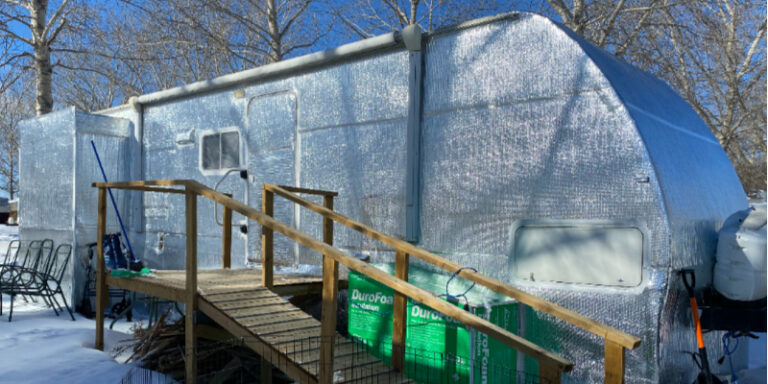
Skirting is the structure around the base of a mobile home to keep the wind out and help keep the pipes from freezing. It isn’t usually used for RVs.
One neighbor helped us build a framework for skirting under the trailer. He made it out of moving pallets. Another neighbor gave us some vinyl that we use to cover the framework to keep the wind out.
Then we had more help to bubble wrap the skirting and the trailer. Our 32-foot holiday trailer is now completely wrapped in bubble wrap, for installation.
Some things we had planned for didn’t work out as we expected. Some unexpected things also came up. They included furnace issues, heated water hoses, the fridge, heated sewer drains, and a frozen water tank inlet. What follows is in the order they happened.
When the part came, and we were in the middle of the chaos of downsizing, I went to the trailer a couple of times to fix the furnace. I have Multiple Sclerosis, and as it progresses it means I sometimes can’t do what I think I can do, and fixing the furnace is one example. But I tried.
I managed to get the furnace out, the new control unit in, the furnace back together, and hooked up to the propane. When I turned it on at the thermostat, it didn’t work. I knew I had done what I could but I needed professional help. I called a technician. He undid most of what I had done and did it right. He had it working in about an hour.
During the summer, we got advice about fridges in RVs. If you have the kind that works on electricity or propane, they don’t work the same as a regular fridge. To work properly, the back of the fridge has to stay warm enough for the coolant not to freeze, but cool enough to cool the coils on the fridge.
Some people use heat traces on the pipes to keep them warm enough. Most people use a light bulb to provide heat and cover the vents to keep the heat in. Then they use some holes or flaps in the covers to let more heat out on warmer days. It’s not so easy for me (Rick) to open and close the flaps, so we decided to use the light but add a thermostatically controlled plug to turn the light off when it got too warm.
We thought we had it set up, but we didn’t. The first time the weather got cold, the fridge stopped working. It turned out that I had accidentally turned the switch off on the trouble light. I ended up taking the thermostat plug out and putting a remote thermometer in. This way, we could tell the light was working because the temperature wasn’t too low and also tell if the temperature was too high. If the temperature gets too high, we will open up the covers. We haven’t had to do it yet…
During the summer we heard horror stories about what happens if the sewer lines freeze up.
One full-time RVer described having a “25-foot poopsicle” that he had to deal with.
Often, RVers will close the black tanks but keep the grey tanks open. This way, you can do laundry and take showers without having to drain tanks every few days.
But with freezing temperatures, the grey water doesn’t all drain away. A little water freezes in the bottom of the hose. The next time, a little more freezes. This happens until finally, you flush the black tank and the hose is full. You end up with maybe 25 feet of frozen poopsicle. What a mess!
One RVer said to always close all tanks, drain them completely every time, and disconnect the drain hose each time. But with my MS, this would be very difficult for me.
Rick found another neighbor who had another solution. He put the 3-inch sewer hose inside a 4-inch rigid plastic pipe with self-regulating heat tape. The rigid pipe ensured a very even slope from the trailer drain to the campground drain. The heat tape meant that no liquid would freeze inside the pipe. Self-regulating heat tape meant that it wouldn’t overheat or have hotspots to melt the pipes.
With this setup, we can leave the grey tank drain open. When the black tank gets full, I close the grey tank drain to avoid back-up. Then I drain the black tank, close the black tank drain, and open the grey tank drain. Winter isn’t over, but we had temperatures as low as minus 31 (-35 C) and nothing froze.
We had an issue with hot water when the temperature dropped to minus 30 or so. A metal fitting where a water supply pipe connected to the hot water tank froze. We hadn’t insulated the pass-through well enough. Neighbors helped us thaw the pipe and add insulation. We also have a small electric heater there to turn on when it gets that cold again.
In January, we woke up one night because the trailer was really cold. We turned on electric heaters to ward off the cold while we figured it out. We called on a neighbor who we had heard talking about how he had fixed his furnace. When we “bumped” the thermostat, the fan would come on, but it wouldn’t heat, and the fan would shut off a couple of minutes later.
Luckily, our neighbor had seen this before. He correctly diagnosed that we needed to replace the sale switch. It is a switch that detects the flow of air through the furnace and shuts it down if there is not enough flow. This protects the furnace from overheating and causing a fire. Our neighbor had one and helped us change it.
Unfortunately, in the process, he accidentally touched a 12-volt wire the thermostat wire and blew the thermostat. It cost $105 Canadian to get a replacement, but we got everything back running. Our friend felt bad that we had to spend money because of his mistake. I reminded him that, without his help, I would have paid more just to have a technician come out for a service call. I think he feels better now.
We will get into some of these subjects in more detail in future posts. If you are interested, be sure to bookmark this page.
It is now February, and we have survived temperatures as low as 31 below zero (-35 C) and we’re doing fine. We have now lived in a bumper pull travel trailer for nine months, including the coldest part of the winter, we hope…
If someone tells you you can’t live in an RV in Alberta, in winter, please point them to this blog.
Happy winter camping in Alberta!